Heidelberg. A major university city in southwestern Germany, situated on the River Neckar. Its cultural and literary significance is rooted primarily in its long academic tradition, its well-preserved historic center, and a landscape that has attracted European and American writers since the 18th century.
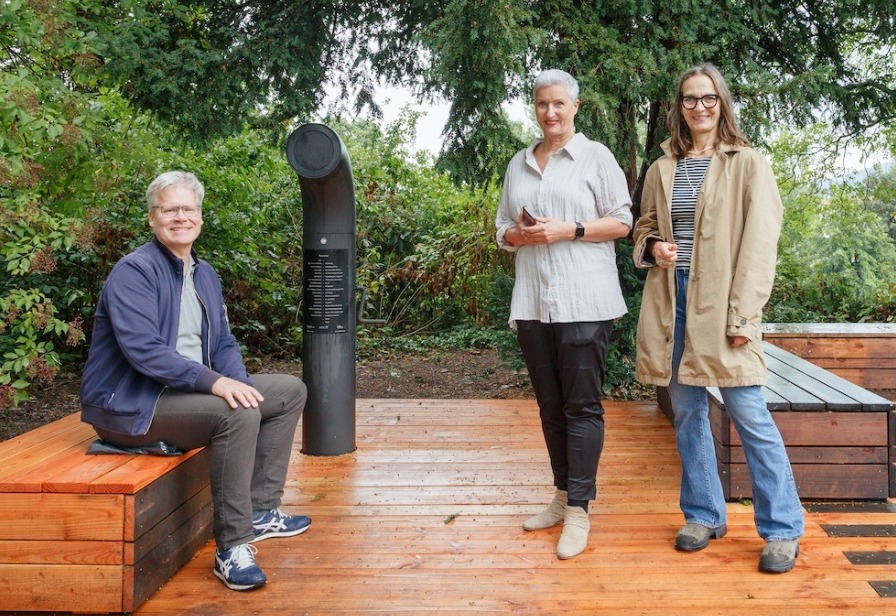
A central role in the city’s history is played by Ruprecht Karl University, founded in 1386. The university environment has shaped both the city’s appearance and its social life—Heidelberg has for centuries been a meeting place for students, scholars, and intellectuals from across Europe. The character of the city is further defined by the ruins of Heidelberg Castle above the River Neckar, which have become a recurring motif in literary and visual works. It is also along the banks of the Neckar that our poetic periscope has been installed, offering a curated selection of significant works connected to Heidelberg.
Among the authors represented are Victor Hugo, Johann Wolfgang von Goethe, and the American writer Mark Twain, who portrayed Heidelberg with distance and humor in his book A Tramp Abroad. Charles Bukowski also had a specific connection to the city, having spent part of his childhood here.
The Poesiomat likewise features literary works by other important figures associated with Heidelberg, ranging from Hölderlin to Saša Stanišić, Clemens Brentano, and Hilde Domin. A special composition is dedicated to the Pakistani poet and philosopher Muhammad Iqbal, after whom the viewpoint overlooking the River Neckar—at the site where the Poesiomat emerges from the ground—is named.
Through the Poesiomat, Heidelberg thus presents itself as a city reflected in literature from multiple perspectives: as an academic center, a historical setting, and a place of personal memory.